
About the spa
The healing waters and mineral springs of Vrnjačka Banja
Vrnjačka Banja has seven known mineral springs. Four are used in treatment — Topla voda, Snežnik, Slatina and Jezero — and water from two is bottled. Here are the basic facts about each spring, how the water is used and what to know before you drink it.

Seven springs at a glance
| Spring | Where | Temperature | Note |
|---|---|---|---|
| Topla voda | centre, historic spa core | 36.5 °C | oldest spring; first analysis 1835 |
| Snežnik | by the Vrnjačka river | 17 °C | in use since 1916; re-tapped 1978–1980 |
| Slatina | by the Lipovačka river | 14 °C | tapped 1923; pavilion from 1937 |
| Jezero | in the park, halfway between Snežnik and Slatina | 27 °C | discovered 1978; pavilion from 1989 |
| Beli izvor | near the mouth of the Lipovački stream | — | not used in treatment |
| Borjak | 700 m upstream of Snežnik | — | not used in treatment |
| Vrnjačko vrelo | by the Kraljevo–Kruševac road | — | water is bottled |
Other sources give different temperatures for Slatina and Snežnik (for example 24 °C for Slatina), as measurements were taken in different years and after new tapping work.
Topla voda — the heart of the spa
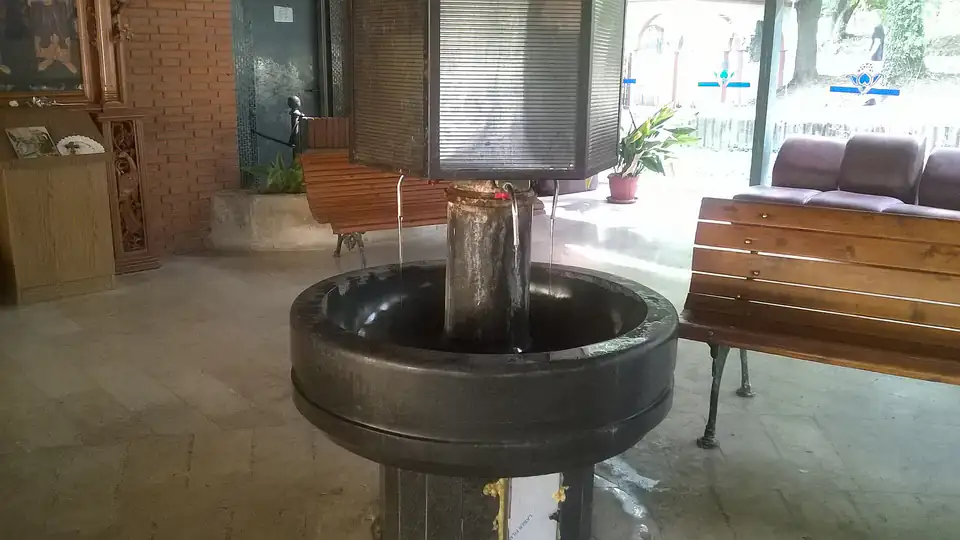
Topla voda ("warm water") rises right in the centre, and the spa grew up around it. The Romans had their bath here, and in 1835 Baron Herder carried out the first chemical analysis of the water. The Kursalon was built in 1883, the first bathhouse in 1892 and the present pavilion in 1975. Water from this spring is bottled under the name Vrnjci. How the Roman bath right beside the spring was uncovered is told in our piece on the Roman spring.
The cold springs: Snežnik and Slatina
Snežnik was known in the late 19th century but has only been used since 1916. The drinking fountain at the spring was built in 1920 by a teacher, Darinka Čavdarović Telebaković. Slatina was tapped in 1923, and the pavilion that still stands was built in 1937. Both springs have cold, naturally carbonated water that is drunk on a walk along the river.
Jezero — the youngest spring
The Jezero ("lake") spring was discovered in 1978 beside a small lake in the park, after which it is named. A new borehole was drilled in 1985 and a modern pavilion built in 1989. The water is moderately warm, at 27 °C.
How the water is used
In the spa the water is traditionally drunk, used for bathing and for inhalation. Treatments are given at the Merkur special hospital for treatment and rehabilitation and in hotel wellness centres; more on accommodation that includes treatments is in our guide to hotels in Vrnjačka Banja.
Health note: this text is for information only and is not a substitute for medical advice. Mineral waters are not for everyone in unlimited amounts — if you have a chronic condition, a kidney or blood-pressure problem, or take medication, talk to your doctor before drinking the water regularly or having spa treatment.
The springs today: less water at the taps
In recent years visitors have noticed that some fountains run with less water. According to an N1 report from October 2024, water at the Jezero spring was flowing from only two taps, and reduced flow was also noticed at Slatina. The mayor said at the time that the springs had not dried up and that the drop was linked to exploratory drilling approved by the relevant ministry. If you are coming specifically for a particular spring, check its current state at the tourist information centre.
Frequently asked questions
Can I drink as much spring water as I like?
You shouldn't. Mineral water has a strong composition and affects the body, so for therapeutic purposes it is drunk in set amounts and at set times of day, as advised by a doctor. A healthy person needs no special advice for a few glasses on a walk, but consult a doctor before drinking it regularly.
Which spring in Vrnjačka Banja is the warmest?
Topla voda, right in the centre, at 36.5 °C. It is the spa's oldest and best-known spring, already used in Roman times.
Why do spring temperatures differ between sources?
Measurements were taken in different years and at different spring heads, and some springs have since been re-tapped. That is why we give the figures from the Vrnjačka Banja Tourist Organisation, noting that other sources give somewhat different values for Slatina and Snežnik.